The short answer
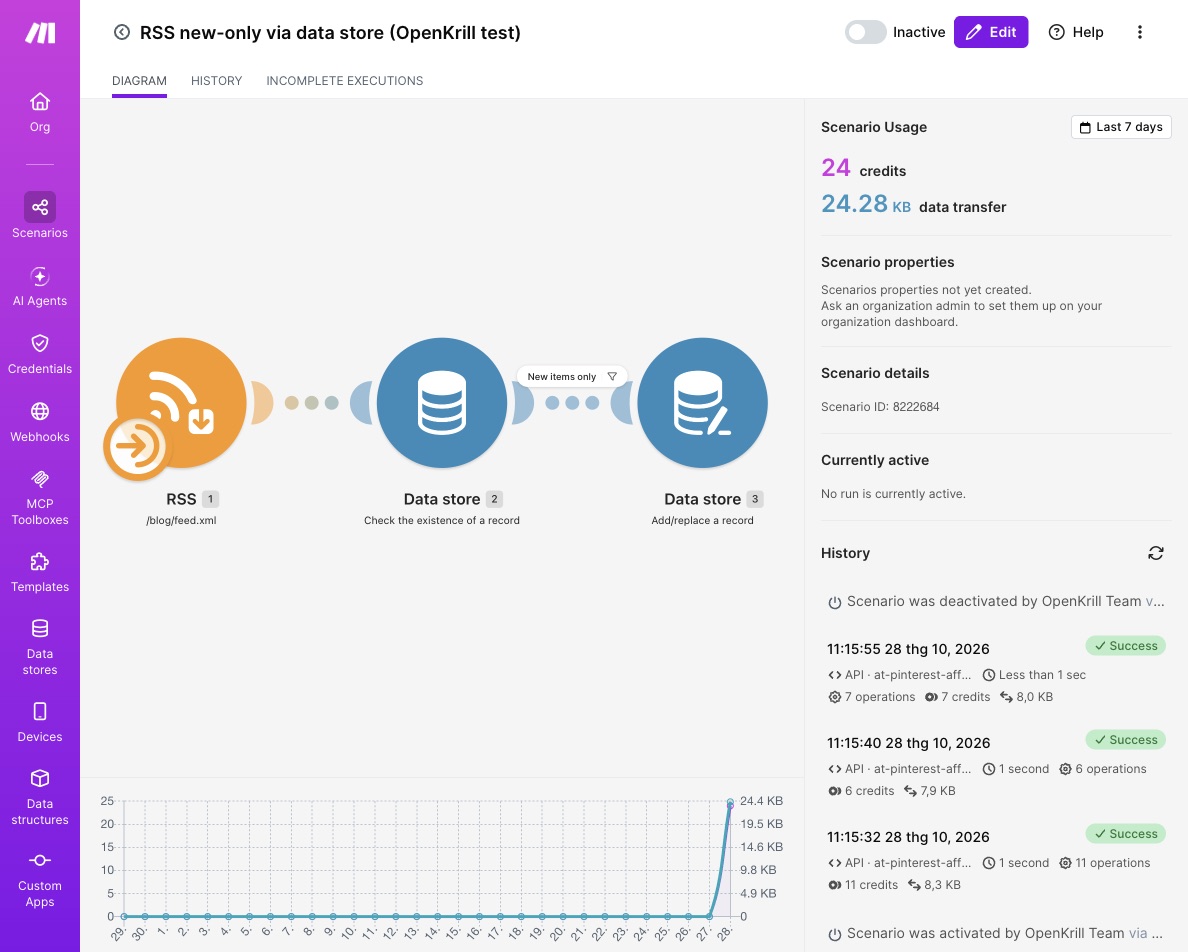
A data store lets a scheduled job remember what it already handled. Our scenario reads the 5 newest posts, checks each address against the store, and adds only the ones it hasn't seen. The check costs 1 credit per item on every run. The add costs 1 credit, and only for new items.
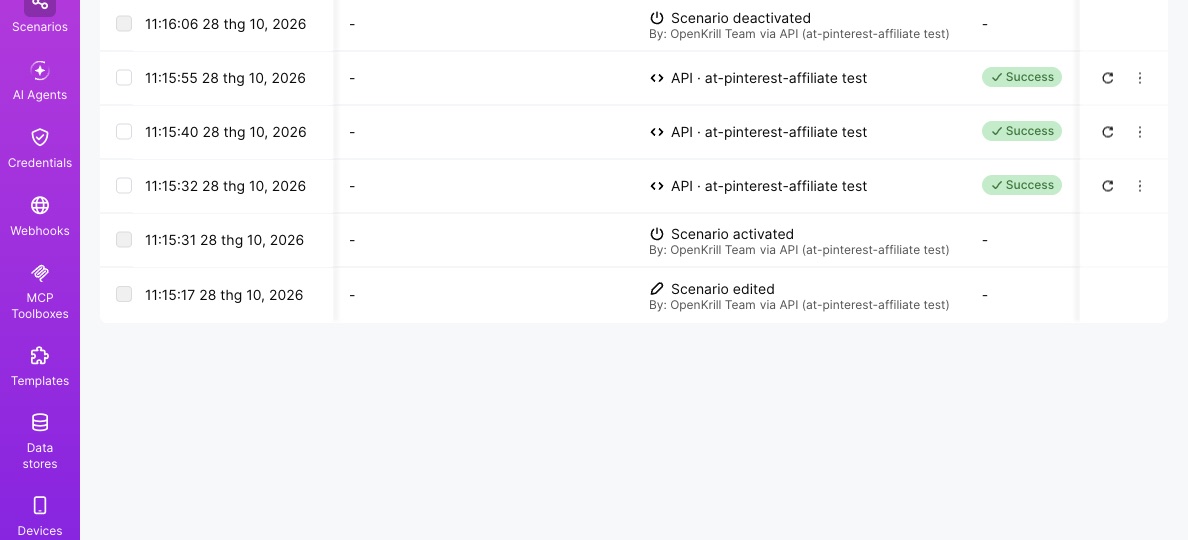
| Run | What the store held before | Addresses added | Credits |
|---|---|---|---|
| 1 | nothing | 5 | 11 (1 feed read, 5 checks, 5 adds) |
| 2 | the same 5 | 0 | 6 (1 feed read, 5 checks) |
| 3 | 4, after we removed 1 | 1 | 7 (1 feed read, 5 checks, 1 add) |
Each run took 1.3 seconds or less in Make's log. We started each run through the API, and the 2 calls we timed came back in about 2.2 seconds.
How we built it
We used a Make account on the free plan and set it up through the Make API with one token. The visual editor takes the same settings.
- Make the data store. We called it "seen-posts", 1 MB, with no data structure. The post address is the record key, and the record holds nothing else.
- Read the feed. We used "RSS: Retrieve RSS feed items" on
https://tools.openkrill.app/blog/feed.xml, at most 5 items. - Check each item. We used "Data store: Check the existence of a record", with the key set to
{{1.url}}. - Add a filter. On the link to the next module, a filter named "New items only" lets an item through only when the check didn't find it.
- Save the new ones. We used "Data store: Add/replace a record", key
{{1.url}}, with overwrite off. Put the work you want done once per new item, such as a post to Slack or a row in a sheet, after this module.
What buyers worry about, and what we found
"Does skipping old items save credits?"
Some. The checks still cost 1 credit per item on every run, so a run with nothing new cost 6 credits, not 1. The saving comes after the filter, because every module behind it runs only for new items. With 3 modules behind the filter, a run with nothing new would still cost 6, while handling all 5 items again would cost 21.
"How many items can the free data store remember?"
Our 5 addresses took 499 bytes, about 100 bytes each. The free plan gives 1 data store of 1 MB, so it holds roughly 10,000 addresses of this length. Shorter keys fit more.
"Why not use the RSS watch trigger instead?"
Make's "Watch RSS feed items" trigger also skips old items, and in our earlier free plan test an empty check cost 1 credit. But it remembers only its own place in one feed. A data store works across feeds, across scenarios, and for sources with no watch trigger, such as a plain API that returns a list.
When a paid plan makes sense
At 6 credits for an empty run, an hourly schedule needs about 4,320 credits a month, well over the free plan's 1,000. A daily run needs about 180. On annual billing, the plans page lists Core at 9 US dollars a month for 10,000 credits, with schedules down to the minute.
What this test does not show
- It was one small feed, 3 runs, one day. We started the runs through the API, not on a schedule.
- We didn't test 2 runs at the same time. Both could check the same new item before either adds it.
- Our records hold only a key. A data structure can store more fields per record, but our API token wasn't allowed to make one.
Frequently asked questions
How do I stop a Make scenario from handling the same item twice?
Save each item's ID or address in a data store. On each run, check for the key, filter out the items found, and add the new ones.
How many credits does a Make data store check use?
1 per item checked, on every run. In our test, 5 checks plus the feed read cost 6 credits when nothing was new.
How much does the Make free plan data store hold?
1 data store of 1 MB. Our post addresses took about 100 bytes each, so about 10,000 of them fit.
Sources
- Make plans: Free with 1,000 credits a month, Core at 9 US dollars a month on annual billing, read 2026-10-21.
- Make API documentation: the API we used to make the data store and scenario, start the runs and read the run log.
- Make affiliate program: the program we joined.